Showing posts with label Joe Ahearne. Show all posts

Saturday, November 3, 2012

#7 (1.8): Father's Day.

Peter Alan Tyler (Shaun Dingwall):
An ordinary man who should not be alive.

1 episode. Approx. 43 minutes. Written by: Paul Cornell. Directed by: Joe Ahearne. Produced by: Phil Collinson.


THE PLOT

Pete Tyler (Shaun Dingwall), Rose's father, was killed by a hit-and-run driver in 1987. Rose begs the Doctor to take her to 1987, so that she can be with him when he dies. "He can't die alone," she pleads. Despite his misgivings, the Doctor agrees - only to watch in horror as Rose sprints out into the street and pushes her father out of the path of the oncoming car.

"There's a man alive who wasn't before... That's the most impotant thing in the world!" The Doctor recognizes the significance of what Rose has done. When he storms back to the TARDIS in anger, unlocks the door, and discovers that the inside has become na empty box - At that point, his worst fears are confirmed. Rose's actions have damaged time. Now the Reapers are coming to clean the wound... by destroying all life on Earth!


CHARACTERS

The Doctor:
 Somewhat ironically for a story in which he spends much of the running time furious with his companion, this is overall the gentlest characterization the prickly 9th Doctor has yet received. For all his anger at Rose, he still instinctively wants to protect her. He may snap at her, but he has no intention of allowing Pete to die again, even though he realizes that his death would end the Reapers' rampage. He also shows genuine compassion for the young couple whose church wedding becomes the site of the final standoff. When the bride asks if he can save them, he surveys this very ordinary young couple, asks a few personal questions, then gives them a warm smile as he assures them that he will do everything he can to get them out alive.

Rose: Has built her father up in her mind to a degree that insures that the real man will disappoint. "I thought he'd be taller," she says upon seeing him in person for the first time. No doubt the Imaginary Pete in her mind towered above all others. Why not? In the stories told by her mother, Pete is nearly perfect, clever and creative and "the most wonderful man in the world." The real Pete is not a bad man by any means, but he is ordinary: His so-called inventions are largely junk destined to go nowhere, and he has no problem with flirting with other women (and possibly more than just flirting) despite his marriage. When Rose describes him as the perfect father, Pete listens, then sadly admits, "That's just not me." 


THOUGHTS

"I'll get it right, love. One day soon, I promise you, I'll get it right."
-Peter Alan Tyler, on the last day of his life

Father's Day is very well-placed in the season. The Long Game ends with a would-be companion booted from the TARDIS for misusing time travel for his own gain. That is fresh in the viewer's mind as Rose does the same thing for different reasons, and therefore there's at least a doubt as to whether the Doctor does truly mean to leave her at this point. It's not a serious doubt - we'll always forgive those we love a lot more than those we barely tolerate - but even the slight doubt wouldn't exist if this had been placed any earlier in the season.

The episode highlights one of the largest divisions between the old series and the new: Emotion. Classic Who was rarely driven by emotion. The stories were external threats, almost invariably faced down by the regulars with courage and resourcefulness. Any emotional material had to squeeze itself around the plot.

This story is driven by emotion. There is no external threat, not until Rose's impulsive actions bring a threat into being. Even then, when the Reapers surround the church leaving the survivors under siege, they are not the story's focus: Rose and her father are. Just as Rose brings the Reapers down by saving her father, the Reapers are driven away by her father saving her and everyone else. Their two acts - one instinctive, the other thought out - bookend the threat, with both deeds based on their relationship as father and daughter.

Paul Cornell's script is manipulative, brazenly so. It's a good script, though: tightly structured, with no real fat at any point, and populated by characters who feel authentic. Pete is as flawed as his marriage to Jackie, which makes him feel real, and makes their marriage feel real. All of this makes the viewer's connection to him and to them so much stronger than might have been. The writer's heavy hand may be very evident, particularly near the end, but that doesn't stop it from packing a wallop.


Rating: 8/10.

Previous Story: The Long Game
Next Story: The Empty Child 

Search Amazon.com for Doctor Who

Review Index

To receive new review updates, follow me:

On BlueSky:

On Threads:

Saturday, October 20, 2012

#5 (1.6): Dalek.

The best of enemies: The Doctor and the Dalek.

1 episode. Approx. 45 minutes. Written by: Robert Shearman. Directed by: Joe Ahearne. Produced by: Phil Collinson.


THE PLOT

The Doctor follows a distress signal to Utah, 2012 - specifically, to the underground museum of Internet billionaire Henry van Statten (Corey Johnson). Van Statten has turned a fortune into an empire by studying alien artifacts that have fallen to Earth, adapting their technology for the marketplace ("Broadband? Roswell!").

But the prize of his collection is a living being which he has dubbed "The Metaltron." The creature is encased in a protective machine, and it refuses to speak. Van Statten's men have tortured it to make it scream, but it still won't talk. Until the Doctor walks into its cage, determined to rescue it from captivity.

Only this machine is no simple victim. It is the last surviving member of the most evil race the Doctor has ever faced. It is a Dalek!


CHARACTERS

The Doctor:
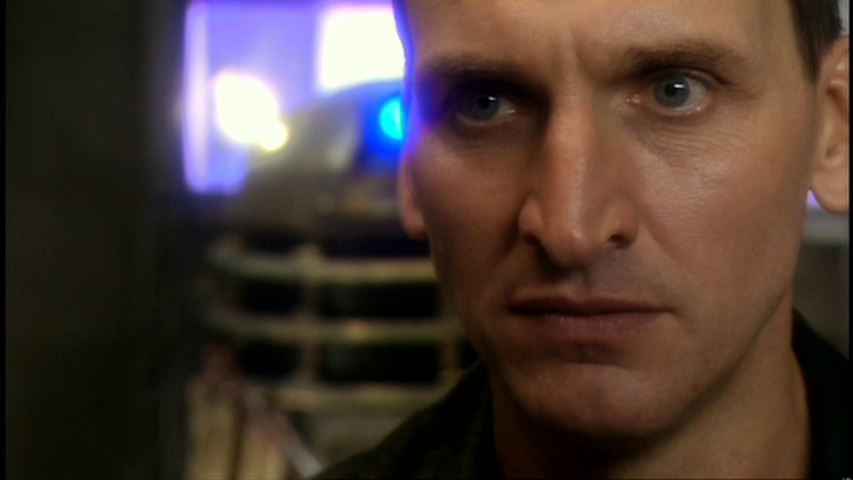
 For the Ninth Doctor, the cheerful cover was never more than a very thin veneer even at the best of times. Christopher Eccleston delivers his best Who performance, showing that cover not so much stripped away as shattered. From the instant he recognizes the Dalek right up to the story's end, he is intensely and nakedly emotional: terrified, desperate, and overflowing with rage. The Doctor's not wrong to call for the creature's death, as the entire first 30 minutes chillingly demonstrate, but it's still disconcerting to see spittle literally fly from his lips as he screams at the Dalek: "Why don't you just die!?!"

Rose: Her compassion compels her to rush to the Dalek's cage when she sees van Statten's men torturing it. She knows nothing of its nature, and it is easily able to manipulate her into touching it - allowing it to extrapolate from her DNA to repair itself. In this way, Rose's compassion sets off the events that lead to so many deaths, something the Doctor's harshness would have prevented had he not been stopped. Still, Rose's ability to identify with the Dalek stops the killing in the end, as the Dalek extrapolates too much of her into itself. More importantly, she is able to defuse the Doctor's rage, leading him back to his usual self by the show's end.

Adam: The first of two stories featuring interim companion Adam Mitchell (Bruno Langley). Rose responds strongly to Adam, openly flirting in their very first proper scene together. Adam's intelligence and lack of respect for authority remind her of the Doctor - a younger, sexually available version of the Doctor. Adam does manage to get on the Doctor's bad side by saving himself by ducking under a descending bulkhead rather than trying to help Rose, but I don't think he can be condemned there. Rose was too many steps behind - All he would have accomplished by lingering would be trapping himself on the wrong side of the bulkhead with her, which would surely have ended in his death in a way that would have been no help to Rose at all.

Dalek: Quite possibly the only new series story in which the Daleks really work.  The story strips the threat down to a single Dalek. Battered and old, it looks more pathetic than frightening. Which makes it all the more effective as it rips through van Statten's small army of guards with no effort at all. We are shown its intelligence, not only through decoding the lock to its cage and "absorbing the Internet," but also viscerally. Surrounded by guards, the Dalek takes in the room. It observes the fire alarm, the sprinkler system, the metal all around... and in three expertly-judged shots, a matter of seconds, it performs a massacre. The spectacle is enough to make Van Statten finally take the thing seriously - and more than enough to sell every viewer on the threat of the Daleks.


THOUGHTS

The episode opens with an effective aside, working both as a nod to the old series and the old fans and as a thematic tie-in with this story. The Doctor and Rose are poking around Van Statten's private museum, when the Doctor comes across the head of a classic series Cyberman. He stares at it through the glass, shocked and a little disgusted at seeing "the stuff of nightmares reduced to an exhibit." There's not even a pause in breath between him observing that and stating that he's "getting old."

Like the Cybermen, the Time Lords and the Daleks are all gone. The stuff of myth and nightmares, reduced to one Time Lord and one Dalek, living relics of an age long past. If van Statten has his way, both Dalek and Doctor will be reduced to museum exhibits - intelligent animals, kept in a private cage for his own entertainment.

Dalek is loosely based on writer Robert Shearman's Big Finish audio, Jubilee. The two stories are very different, however.  Their only real similarities are the idea of a single, imprisioned Dalek and a similar (though not identical) Doctor/Dalek confrontation scene.

I like Jubilee better overall, but the Doctor/Dalek scene in Dalek is by far the stronger confrontation. With the Time War backstory, it's more meaningful. Instead of simply being a verbal confrontation between the Doctor and a Dalek, it is a confrontation between the last Time Lord and the last Dalek, the start of what would seem to be the final battle of that war. All "Doctorish" elements drop away from Eccleston's performance in an instant, as he taunts his enemy, blocks out its words about them being the same, and finally embraces that charge by attempting to kill the Dalek - even preceding his attempt by intoning the Dalek catchphrase: "Exterminate!" It's been seven years since Doctor Who returned to television as I write this, and this remains the most intense scene the series has presented.

The first thirty minutes of Dalek are magnificent. It's a very stripped-down episode: a single Dalek on a rampage, Rose and Adam on the run from it, and the Doctor determined to not only stop it but obliterate it. The script is taut, smart, and suspenseful, the pace driving relentlessly right up to the instant that bulkhead closes with Rose caught on the wrong side of it.

And then, it all falls apart.

There is nothing in the first thirty minutes of Dalek that does not work for me. Unfortunately, there is little in the last ten minutes that does work. The Dalek doesn't transform gradually. Despite an attempt to plant something early on in the Dalek focusing on Rose, it still behaves as a traditional Dalek - albeit a traditional Dalek on steroids. But once that bulkhead closes, it suddenly becomes a completely different entity.

Maybe if the Dalek spared only Rose, because of its connection with her, but continued to exterminate everyone else... Maybe then it wouldn't feel so completely out of place dramatically. But its sparing of van Statten and Goddard (Anna-Louise Plowman) is a step too far. The Dalek goes from "alien death machine" to "grumpy puppy" with practically no transition, and that last ten minutes feels like it belongs to a very different episode, a very much worse one.

If I was as enthusiastic about the show's ending as I am about the rest of it, this would be the best Ninth Doctor episode. It's still a decidedly above-average episode, with a stunning performance by Christopher Eccleston and some of the best moments in the entire new series. The ending fails badly for me, though, transforming a great episode into merely a very good one.


Rating: 8/10.

Previous Story: Aliens of London
Next Story: The Long Game

Search Amazon.com for Doctor Who

Review Index

To receive new review updates, follow me:

On BlueSky:

On Threads: